Lavender
Lavender: How to Grow a Full, Blooming Plant
Lavender (Lavandula angustifolia) is one of those rare plants that manages to be both effortlessly elegant and surprisingly resilient. With its silvery foliage, soft purple blooms, and unmistakable fragrance, it has been cherished for centuries—not only in gardens, but also in medicine, perfumery, and daily life. In fact, the name “lavender” comes from the Latin lavare, meaning “to wash,” because the Romans used it to scent their baths, linens, and homes.
Today, lavender remains a symbol of calm and simplicity—but growing it successfully requires understanding one important principle: lavender prefers neglect over care.
Lavender (Lavandula angustifolia) is one of those rare plants that manages to be both effortlessly elegant and surprisingly resilient. With its silvery foliage, soft purple blooms, and unmistakable fragrance, it has been cherished for centuries—not only in gardens, but also in medicine, perfumery, and daily life. In fact, the name “lavender” comes from the Latin lavare, meaning “to wash,” because the Romans used it to scent their baths, linens, and homes.
Today, lavender remains a symbol of calm and simplicity—but growing it successfully requires understanding one important principle: lavender prefers neglect over care.
- Where Lavender Truly Thrives
- Lavender is a plant of the Mediterranean, which tells you everything about its preferences. It wants sun, air, and dry soil—conditions that many garden plants struggle with.
- Choose a spot with full sun for at least 6–8 hours a day and good airflow. Lavender dislikes still, damp environments, so avoid low areas where moisture collects.
- The soil matters even more. Lavender does not tolerate heavy, wet ground. It prefers light, well-drained soil, slightly alkaline if possible. If your soil is dense or clay-based, it’s worth improving it with sand or gravel. Think of recreating a dry hillside rather than a rich garden bed.
- A useful rule: if you’re unsure whether to water - don’t.
- Watering: Less Is More
- This is where many gardeners go wrong. Lavender is not a thirsty plant.
- Young plants need some support while establishing, so light, regular watering is fine at first. But once established, lavender should only be watered during prolonged dry periods.
- Overwatering is the most common reason lavender fails. Roots sitting in moisture quickly lead to rot—and once that starts, recovery is difficult.
- Pruning: The Secret to Beauty and Repeat Bloom
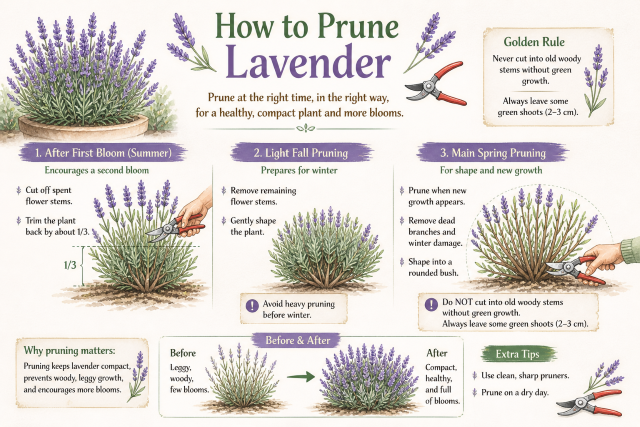
- Lavender without pruning becomes woody, sparse, and uneven. With proper pruning, it stays compact, lush, and can even bloom twice.
- After the first bloom in summer, cut back the faded flower stems and lightly trim the plant—about one-third. This encourages a second, lighter bloom later in the season.
- In early fall, a gentle shaping helps maintain form, but avoid heavy pruning before winter. Lavender needs its structure to protect itself from cold.
- The most important pruning happens in spring, when new growth appears. Remove any dead or damaged branches and shape the plant into a soft, rounded mound.
- There is one critical rule gardeners learn the hard way: never cut into old woody stems that show no green growth. Lavender does not regenerate well from bare wood. Always leave a small cushion of green shoots—this is where new life begins.
-
- How to Get More Flowers
- Lavender does not respond to pampering—it responds to restraint.
-
To encourage abundant blooms (and even a second flowering), give it:
- - as much sun as possible
- - excellent drainage
- - modest soil (not rich)
- - pruning after flowering
- Interestingly, lavender often blooms better when it is slightly “stressed.” Overfeeding or overly rich soil leads to lush leaves—but fewer flowers.
- Feeding Lavender (Very Lightly)
- Unlike many flowering plants, lavender is not a heavy feeder. In fact, too much fertilizer does more harm than good.
- A light application of compost or a low-nitrogen fertilizer in early spring is enough. If your soil is particularly poor, a second light feeding after the first bloom can help—but this is optional.
- Too much nitrogen encourages leafy growth at the expense of flowers, which defeats the whole purpose of growing lavender.
- Winter Care
- Lavender’s biggest enemy in winter is not cold—it’s moisture.
- Avoid heavy mulching, which can trap water around the base. Instead, use gravel or very light protection, such as evergreen branches, to shield from harsh winds while allowing airflow.
- Companion Plants
-
Lavender pairs beautifully with plants that share its love of sun and dry soil. In both design and care, it works well alongside:
- Rosa (roses)
- Salvia nemorosa (salvia)
- Nepeta (catmint)
- Echinacea purpurea (coneflower)
- Thymus vulgaris (thyme)
- Santolina chamaecyparissus (santolina)
-
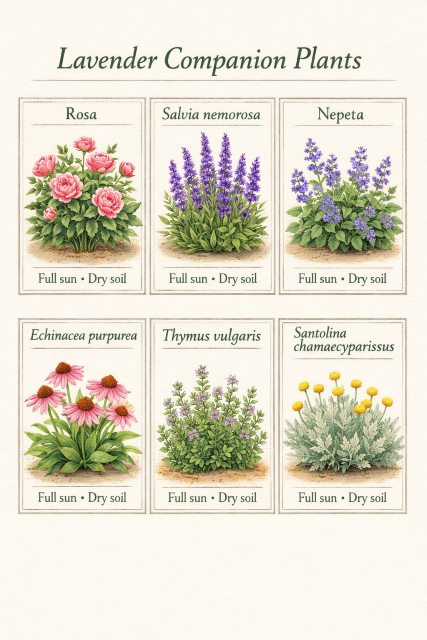
- Together, they create a garden that is not only beautiful, but also cohesive in its needs.
-
Lavender pairs beautifully with plants that share its love of sun and dry soil. In both design and care, it works well alongside:
- Common Mistakes (and Why They Happen)
-
Most lavender problems come from treating it like other garden plants. The most common issues include:
- - overwatering
- - heavy or clay soil
- - cutting too deeply into old wood
- - over-fertilizing
- - too much shade
- Each of these goes against lavender’s natural habitat—and the plant responds accordingly.
-
Most lavender problems come from treating it like other garden plants. The most common issues include:
- A Simple Way to Think About Lavender
-
Lavender thrives on simplicity. Give it:
- - plenty of sun
- - dry, well-drained soil
- - minimal feeding
- - and timely pruning
- In return, it will reward you with fragrance, color, and a quiet, timeless beauty that has been valued since ancient Roman gardens.
-
Lavender thrives on simplicity. Give it:
Plants in Garden