Few fruits are as closely connected to summer as peaches. A ripe peach picked directly from the tree is almost impossible to compare with fruit from a grocery store. The fragrance appears before the first bite, the flesh softens in the hand, and the sweetness seems to capture an entire season of sunshine.
Peach trees (Prunus persica) have accompanied gardeners and orchardists for thousands of years. They are beautiful in spring, productive in summer, and surprisingly ornamental throughout the growing season. Their clouds of pink blossoms often rival flowering cherries, while their fruit has inspired poets, artists, and cooks around the world.
Although peaches have a reputation for being more demanding than apples, they reward attentive gardeners with harvests that simply cannot be purchased. A homegrown peach, warmed by the sun and picked at perfect ripeness, is one of the great pleasures of the garden.
- A A Tree with a Long and Fascinating History
- One of the biggest surprises about peaches is that they did not originate in Persia, despite their botanical name Prunus persica. Modern research shows that peaches were first domesticated in China more than 4,000 years ago.
- Ancient Chinese artists painted peaches, poets wrote about them, and emperors planted them in palace gardens. Peaches became symbols of immortality, good fortune, and long life. In Chinese mythology, magical peaches grown in the garden of the Queen Mother of the West were said to ripen only once every several thousand years. Those fortunate enough to eat them would gain eternal life.
- From China, peaches traveled west along the Silk Road, eventually reaching Persia. European travelers encountered them there and assumed the fruit originated in that region. The Romans later spread peaches throughout Europe, where they became prized additions to monastery gardens, royal estates, and cottage orchards.
- Today peaches are grown around the world, but they still carry much of the symbolism they held thousands of years ago: prosperity, abundance, happiness, and the pleasures of summer.
- Why Gardeners Love Peach Trees
- Peach trees offer beauty during nearly every season.
- In early spring, before many plants awaken, bare branches become covered in delicate pink blossoms. These flowers are not only beautiful but also highly attractive to bees and other pollinators.
- By summer, the tree develops a dense canopy of bright green leaves that protect ripening fruit from intense sunlight. As harvest approaches, branches become decorated with peaches in shades of yellow, gold, orange, crimson, and pink.
- Unlike some fruit trees that may take many years to become productive, peaches often begin producing fruit while still relatively young. This makes them especially rewarding for home gardeners.
- The Secret to Sweet Peaches: Sunlight
- If there is one thing peaches love above all else, it is sunshine
- A peach tree should receive at least six to eight hours of direct sunlight every day. More sunlight means stronger growth, sweeter fruit, better color, and fewer disease problems.
- Many gardeners are disappointed when a healthy-looking peach tree produces small or bland fruit. Often the cause is not fertilizer or watering—it is simply insufficient sunlight.
- Peaches are children of warm, sunny hillsides. They evolved in places where sunlight was abundant, and they perform best when given the brightest location available.
- Planting Peach Trees Correctly
- Peaches prefer fertile, well-drained soil rich in organic matter. Heavy, waterlogged soil is one of the few conditions they truly dislike.
-
When planting a peach tree:
- - choose a sunny location
- - provide good air circulation
- - avoid low spots where cold air settles
- - improve heavy soil with compost if necessary
- The planting hole should be wide rather than excessively deep. The tree should sit at approximately the same depth it grew in the nursery.
- A common mistake is planting too deeply. When the trunk flare becomes buried, growth often slows and the tree becomes more vulnerable to disease.
- Why Pruning Matters More Than Most Gardeners Realize
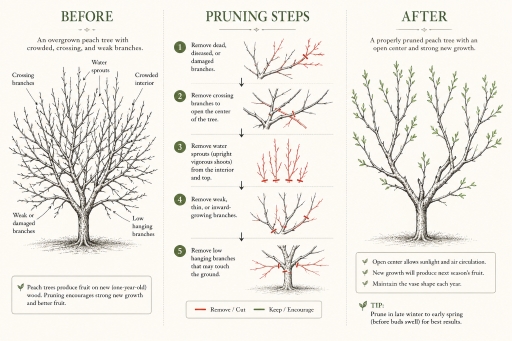
- Many gardeners hesitate when pruning fruit trees. Removing healthy branches feels wrong.
- Peaches, however, depend on pruning.
- Unlike apples, which can produce fruit on older wood for many years, peaches bear most of their fruit on shoots that grew during the previous season. If the tree becomes crowded, older branches shade the younger wood and productivity gradually declines.
-
Without pruning, peach trees often become larger while producing smaller and fewer peaches.
-
Proper pruning accomplishes several goals:
- - allows sunlight into the canopy
- - improves air circulation
- - encourages new fruiting wood
- - reduces disease pressure
- - produces larger peaches
- In fact, many poor peach harvests result from too little pruning rather than too much.
- Understanding the Open-Center Shape
- Peach trees are traditionally trained into what growers call an "open-center" or "vase" shape.
- Instead of maintaining a single central trunk extending upward, the middle of the tree remains open. Several strong scaffold branches form the framework while sunlight reaches deep into the canopy.
- Imagine turning a large bowl upside down. That open structure allows light and air to reach nearly every branch.
- This design is one reason commercial orchards can consistently produce large, sweet peaches year after year
- Why Thinning Fruit Produces Better Harvests
- One of the hardest lessons for beginning peach growers is learning to remove healthy young fruit.
- After flowering, peach trees often set far more peaches than they can properly support. Left alone, the tree attempts to ripen every fruit, resulting in small peaches and heavily stressed branches.
- Professional growers routinely thin their trees.
- Young peaches should be spaced roughly six to eight inches apart after natural fruit drop.
- At first this feels wasteful. However, the tree can then focus its energy on fewer fruits, producing peaches that are dramatically larger, sweeter, and more flavorful.
- Many gardeners say this single practice improves harvest quality more than any fertilizer.
- Feeding Peach Trees Without Overdoing It
- Peaches appreciate fertile soil, but they are not heavy feeders.
- Too much fertilizer—especially nitrogen—creates vigorous leafy growth while reducing fruit quality.
-
A balanced fertilizer such as:
- - 10-10-10
- - 5-10-10
- - compost and well-rotted manure
- The best time to fertilize is early spring before vigorous growth begins.
- A peach tree growing strongly and producing healthy foliage often needs surprisingly little additional feeding.
- As with many fruit trees, more fertilizer does not automatically mean more fruit.
- Watering for Better Fruit
- Young peach trees need regular watering while establishing roots.
- Mature trees are somewhat drought tolerant, but consistent moisture becomes especially important during fruit development.
- Deep watering is better than frequent shallow watering. A thorough soaking encourages roots to grow deeper into the soil, making the tree more resilient during summer heat.
- Extreme drought during fruit development can lead to smaller peaches and reduced sweetness.
- Common Problems and What They Mean
Peach trees occasionally face challenges, but many problems can be prevented through good cultural practices.
-
Peach Leaf Curl
Peach leaf curl is one of the most recognizable peach diseases. Leaves become distorted, thickened, and puckered.
The disease is caused by a fungus that infects new growth during cool, wet weather.
Fortunately, prevention is much easier than treatment. Dormant-season fungicide applications are highly effective when applied at the proper time.
After autumn leaf drop, the tree enters dormancy. To most gardeners, the season feels finished.
To the fungus, however, winter is simply a waiting period.
A fungicide applied after most leaves have fallen coats the bark, twigs, and buds where fungal spores spend the winter. This first application dramatically reduces the number of spores available to infect new growth.
Many peach growers stop there.
But in regions with wet winters and unpredictable springs—including much of New York—the best protection usually comes from a second dormant spray.
Apply it in late winter or very early spring, before buds begin to open
Many experienced orchardists consider this second spray their insurance policy against a rainy spring.
Choosing the Right Fungicide
Copper FungicidesCopper has protected fruit trees for generations and remains one of the most trusted treatments for peach leaf curl.
Many gardeners prefer copper because it is widely available, relatively simple to use, and accepted in many organic gardening programs.
Copper works by killing fungal spores before they enter the buds.
For many home orchards, annual copper sprays provide excellent control year after year.
ChlorothalonilCommercial orchards often rely on chlorothalonil-based fungicides because of their exceptional effectiveness.
Many university extension programs continue to recommend chlorothalonil as one of the most reliable treatments for peach leaf curl.
Used during dormancy, it provides outstanding protection against infection.
Lime SulfurBefore modern fungicides became common, lime sulfur was the traditional orchard remedy.
The strong sulfur smell tends to be memorable. Many old gardeners can instantly recognize it because nearly every fruit orchard once used it during dormant-season spraying.
-
Brown Rot
Brown rot affects blossoms and fruit, especially during wet weather.
Improving airflow through pruning and removing infected fruit can greatly reduce problems.
-
Poor Fruit Production
If a peach tree produces few peaches, the causes often include:- - insufficient sunlight
- - frost damage to blossoms
- - lack of pruning
- - excessive nitrogen fertilizer
- - poor pollination conditions during bloom
-
Peach Leaf Curl
- Harvesting Peaches
- Unlike apples, peaches continue ripening after harvest, but their best flavor develops when they remain on the tree as long as possible.
- A ripe peach should feel slightly soft when gently pressed and develop its characteristic fragrance.
- The background color often changes from green to creamy yellow or golden tones as fruit matures.
- Peaches harvested too early may soften indoors but rarely develop the full sweetness and aroma of tree-ripened fruit.
- Companion Plants for Peach Trees
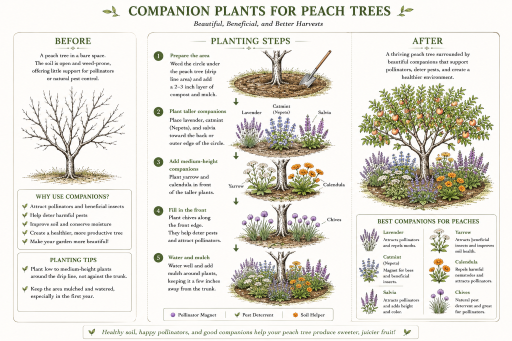
- A peach tree can become the centerpiece of an edible landscape.
-
Excellent companions include:
- Lavender (Lavandula angustifolia) attracts bees and other pollinators that improve fruit set and increase peach production. Its strong aromatic oils may also help confuse or deter certain pest insects. As a bonus, it thrives in the same sunny, well-drained conditions that peaches enjoy.
- Catmint (Nepeta) is a pollinator magnet. Bees often cover it from spring through fall, helping ensure peach blossoms receive plenty of visits during bloom time. Its aromatic foliage may also discourage some nuisance insects.
- Salvia (Salvia nemorosa) produces long-lasting flower spikes rich in nectar, attracting bees, butterflies, and beneficial insects. These beneficial insects help maintain a healthier orchard ecosystem and can assist in controlling pest populations naturally.
- Yarrow (Achillea millefolium) is one of the best plants for attracting beneficial predatory insects, including ladybugs, lacewings, and parasitic wasps. These insects feed on aphids and other pests that may attack peach trees. Yarrow also improves biodiversity around the tree.
- Calendula (Calendula officinalis) attracts pollinators while helping support beneficial insects. Many gardeners plant it near fruit trees because its roots may help suppress certain harmful soil nematodes. Its bright flowers also bloom over a long season, keeping pollinators in the garden.
- Chives (Allium schoenoprasum) belong to the onion family and have a reputation for helping repel aphids and some other insect pests. Their purple spring flowers attract pollinators, while the foliage remains neat and easy to grow beneath fruit trees.
-
Together these plants create what orchardists call a living guild around the peach tree:
- lavender, catmint, and salvia attract pollinators
- yarrow attracts beneficial predator insects
- calendula supports pollinators and soil health
- chives help deter certain pests
- The result is a peach tree surrounded by flowers that bring in the "good bugs" while helping reduce the impact of the troublesome ones—a classic cottage-garden approach that is both beautiful and practical.
- Spring bulbs can also provide color before the tree leafs out fully.
- Peaches in the Kitchen
- For thousands of years peaches have appeared in desserts, preserves, wines, and sauces.
- In Victorian gardens, peaches were often trained against warm walls where the fruit could ripen more reliably. Gardeners considered a basket of homegrown peaches one of the greatest luxuries of summer.
- Today peaches remain equally versatile. They can be enjoyed fresh, baked into pies, transformed into jams, grilled, dried, or added to savory dishes.
- Many gardeners discover that their greatest challenge is not growing peaches—it is finding enough ways to use them all.
Peach trees ask for a little attention. They need sunlight, pruning, occasional thinning, and a watchful eye for disease. Yet few fruit trees repay that effort so generously.
A peach tree in bloom is one of spring's loveliest sights. A peach tree loaded with ripening fruit is one of summer's most satisfying rewards.
And when you finally pick a perfectly ripe peach and taste fruit that has never known a grocery shelf, it becomes easy to understand why people have treasured peach trees for more than four thousand years.